Saturn in the houses: Where life asks us to grow up

Summary
- Saturn in the houses shows where we experience pressure, responsibility, or delay in life.
- It reflects which life area may feel heavy or complex early on, but becomes a source of mastery over time.
- Each house reveals a domain where we’re asked to develop structure, resilience, and a realistic approach to limitations.
- While these placements often point to real-world challenges—family instability, blocked ambitions, difficult relationships—they ultimately describe how we respond to these conditions.
- The house where Saturn sits is where we’re called to build something lasting, meaningful, and rooted in personal integrity.
Saturn in the first house – General, positive, and negative traits

General traits of Saturn in the first house
-
A serious or self-conscious early self-image
Individuals often carry a strong sense of responsibility about “being someone,” leading to early pressure to appear composed or capable.
-
Guardedness in personal expression
There may be hesitation or restraint in expressing themselves spontaneously, especially when self-worth feels conditional.
-
A tendency to internalize high standards
Their identity often revolves around living up to ideals of strength, competence, or moral integrity, even if these are self-imposed.
-
Slow but deliberate identity development
A strong sense of self emerges gradually through experience, rather than being assumed or easily adopted in youth.
-
Physical presence shaped by restraint or discipline
People with this placement may carry themselves with quiet authority or visible tension, shaped by bodily awareness or control.
Saturn in the second house – General, positive, and negative traits
General traits of Saturn in the second house
-
A cautious or measured approach to security
Individuals tend to be deliberate about how they establish material and emotional stability, often valuing safety over spontaneity.
-
Self-worth linked to productivity or discipline
There is often a belief—sometimes implicit—that being valuable means being useful, reliable, or materially self-sufficient.
-
Anxiety around financial independence
Even when outwardly successful, many live with a background fear of insufficiency or of losing what they’ve built.
-
Delayed or slow-building confidence in self-worth
A solid sense of value and resourcefulness develops over time, through repeated effort and personal accountability.
-
A strong internal code around ownership and responsibility
People with this placement may be intensely private or protective of their resources—emotional, material, or relational.
Saturn in the third house – General, positive, and negative traits

General traits of Saturn in the third house
-
A thoughtful and deliberate communication style
Individuals with Saturn in the third house tend to speak with care. Words are chosen precisely, often reflecting an inner editor or sense of responsibility about being understood.
-
Cautious early learning experiences
Many approach learning with seriousness or hesitation. They may have felt pressure to "get it right," leading to slow but steady intellectual development.
-
A reserved or observant social presence
In group settings, they may speak less but listen more. Relationships with siblings or peers are often complex, carrying early expectations or constraints.
-
Strong need for mental clarity and order
These individuals often organize their thoughts methodically. They can be drawn to structured thinking, writing, or systems of knowledge that offer security.
-
Internalized pressure to be intelligent or articulate
Their self-worth may be tied to how clearly they can express ideas or how competent they appear in intellectual or social environments.
Saturn in the fourth house – General, positive, and negative traits
General traits of Saturn in the fourth house
-
A deep sense of responsibility around family or home
Individuals with Saturn in the fourth house often carry a private, internal pressure to hold things together—emotionally or practically—within the family system.
-
Emotionally reserved or guarded at home
They may have learned to contain their feelings early in life, especially if expressions of vulnerability felt unsafe or discouraged.
-
A cautious relationship to emotional security
These individuals often take time to feel safe, even in environments meant to offer comfort. Stability is valued but rarely taken for granted.
-
Mature or serious early home life
Many grew up quickly, often taking on adult roles in childhood or experiencing the home as a place of duty more than ease.
-
Strong identification with privacy and emotional control
Their inner world is protected, sometimes fiercely. They may reveal little and prefer to manage emotions quietly, behind closed doors.
Saturn in the fifth house – General, positive, and negative traits
General traits of Saturn in the fifth house
-
A serious or reserved approach to self-expression
Individuals with Saturn in the fifth house often feel pressure around expressing themselves creatively, playfully, or romantically. There may be hesitation where others are spontaneous.
-
Inhibition in joy, play, or affection
They may struggle to relax into lightness or pleasure, especially if early life experiences tied fun to guilt, duty, or fear of judgment.
-
Creativity shaped by discipline
Many express themselves through structured forms—writing, design, planning—where form and focus are valued over spontaneity.
-
Guardedness in romance or vulnerability
Romantic relationships may develop slowly, often marked by caution or high standards for intimacy, authenticity, or commitment.
-
A deep need to earn recognition or love
Self-worth is often tied to being seen as exceptional or valuable, especially in creative or personal arenas. But there is often fear around visibility.
Saturn in the sixth house – General, positive, and negative traits
General traits of Saturn in the sixth house
-
A deep sense of duty around work and service
Individuals with Saturn in the sixth house often carry a quiet but strong sense that they must be competent, useful, and responsible in their everyday tasks.
-
Structured and disciplined approach to daily life
They tend to thrive in environments with routine, order, and clear expectations—though they may also feel trapped by them.
-
Internal pressure to be efficient or flawless
Self-worth is frequently tied to productivity. Even small mistakes can trigger self-criticism or feelings of inadequacy.
-
Strong concern with physical health or functioning
The sixth house governs the body and wellness. Saturn here may bring a cautious or vigilant relationship with health and bodily limits.
-
High standards in work, but slow self-approval
These individuals often work hard, but struggle to feel satisfied or acknowledged, especially by themselves.
Saturn in the seventh house – General, positive, and negative traits
General traits of Saturn in the seventh house
-
A serious and cautious approach to relationships
Individuals with Saturn in the seventh house tend to take commitment seriously. They may be slow to form close partnerships, but once committed, they tend to stay.
-
High standards and expectations in others
There is often a quiet pressure to “get relationships right”—which may lead to hesitancy, perfectionism, or emotional distance in early bonds.
-
Fear of dependence or rejection
Relationships can be fraught with ambivalence: a longing for closeness, paired with a fear of losing self, control, or dignity.
-
Delayed or hard-earned intimacy
Romantic or personal partnerships may arrive later in life, or come after difficult early experiences that taught them about emotional boundaries.
-
A deep need for trust, loyalty, and structure
These individuals often value clarity in commitments and may avoid relationships that feel unstable, dramatic, or emotionally ambiguous.
Saturn in the eighth house – General, positive, and negative traits
General traits of Saturn in the eighth house
-
A serious and private relationship to intimacy and vulnerability
Individuals with Saturn in the eighth house often protect their inner world carefully, revealing themselves only when trust has been earned over time.
-
Cautious engagement with emotional or financial entanglements
They may approach shared resources, deep emotional bonds, or sexual intimacy with hesitation—often needing structure to feel safe.
-
Fear of powerlessness or loss of control
There’s often a deep-seated concern about being dependent on others, emotionally exposed, or vulnerable to betrayal or abandonment.
-
Slow but profound psychological insight
These individuals often understand emotional complexity deeply—but only after learning to tolerate discomfort, fear, or ambiguity within themselves.
-
Ambivalence about transformation and surrender
The eighth house governs processes of death, rebirth, and surrender. Saturn here brings a desire to manage or delay what feels chaotic or uncontrollable.
Saturn in the ninth house – General, positive, and negative traits
General traits of Saturn in the ninth house
-
A serious, grounded approach to beliefs and meaning
Individuals with Saturn in the ninth house often approach philosophy, religion, or worldview-building with caution, depth, and skepticism. They seek truth, but want it to hold up under scrutiny.
-
A cautious or delayed relationship with higher education
Many take longer to find their intellectual or academic path. Formal learning may involve obstacles, but also persistence and long-term achievement.
-
Desire to make abstract ideas useful
These individuals often bring structure and practicality to systems of thought—translating big ideas into something applicable and real.
-
Inner pressure to be wise, knowledgeable, or “correct”
Beliefs are taken seriously and can be internalized as identity. There may be discomfort with not knowing, or a fear of being wrong or intellectually inadequate.
-
A slow-building worldview shaped by life experience
Rather than adopting ideas easily, they often develop their convictions gradually—through time, testing, and lived exploration.
Saturn in the tenth house – General, positive, and negative traits
General traits of Saturn in the tenth house
-
A strong internal drive for achievement and respect
Individuals with Saturn in the tenth house often feel a deep responsibility to “become someone.” Public image, success, and long-term goals carry psychological weight.
-
Early pressure around career or life direction
They may have grown up feeling they had to prove themselves—either to authority figures, family, or society at large.
-
A cautious but determined approach to ambition
They rarely rush into public life or leadership. Instead, they build carefully, often holding themselves to higher standards than others do.
-
A complex relationship with authority and visibility
These individuals often feel ambivalent about being seen: they want to lead or succeed, but fear exposure, criticism, or failure.
-
Success that comes slowly—but with lasting impact
Saturn in the tenth house rarely points to early fame. Instead, it reflects a long arc of professional or personal growth marked by persistence.
Saturn in the eleventh house – General, positive, and negative traits
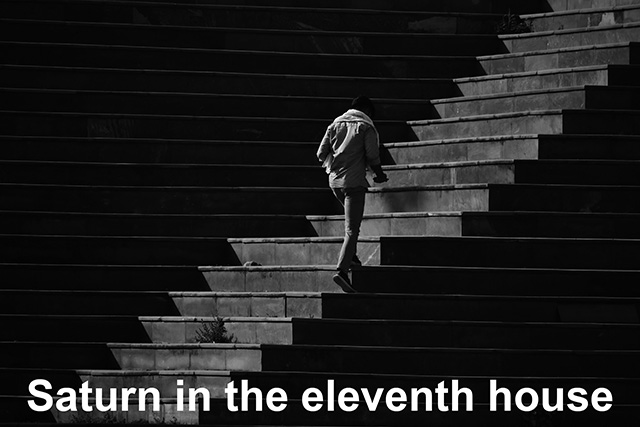
General traits of Saturn in the eleventh house
-
A reserved or selective approach to friendship and community
Individuals with Saturn in the eleventh house often feel cautious in social groups. They may struggle with belonging, or feel pressure to prove their worth in social contexts.
-
High standards for connection and loyalty
While slow to form friendships, they are deeply loyal once trust is established. They prefer depth over quantity in social bonds.
-
A serious commitment to collective goals
These individuals often feel responsible for making a meaningful contribution to their community or society. Idealism is tempered by realism.
-
Fear of rejection or exclusion from groups
Even when surrounded by others, they may carry a subtle sense of not quite fitting in—or needing to earn their place.
-
A cautious relationship to hopes and future visions
Dreams may be big, but they often approach them with skepticism or pressure to make them “realistic” before allowing themselves to hope.
Saturn in the twelfth house – General, positive, and negative traits

General traits of Saturn in the twelfth house
-
A deeply internalized sense of responsibility or guilt
Individuals with Saturn in the twelfth house often carry a background sense that they must hold things together—emotionally, spiritually, or even unconsciously—for others or the world.
-
Strong psychological boundaries—often developed through solitude
They may seek privacy and quiet as a way to manage internal pressure, or to process emotions that are difficult to name or share.
-
Fear of emotional chaos or losing control
These individuals often feel vulnerable in the face of strong emotions, unconscious material, or unstructured experiences. Control is used to maintain emotional survival.
-
A tendency to hide struggles or suppress needs
Difficult feelings may be buried rather than expressed. There's often a belief that showing vulnerability will lead to rejection, weakness, or being overwhelmed.
-
A natural gravitation toward service, healing, or inner work
Many are drawn to behind-the-scenes roles or quiet forms of spiritual or emotional care—especially once they learn to navigate their own inner world.