Saturn in the fourth house – General, positive, and negative traits
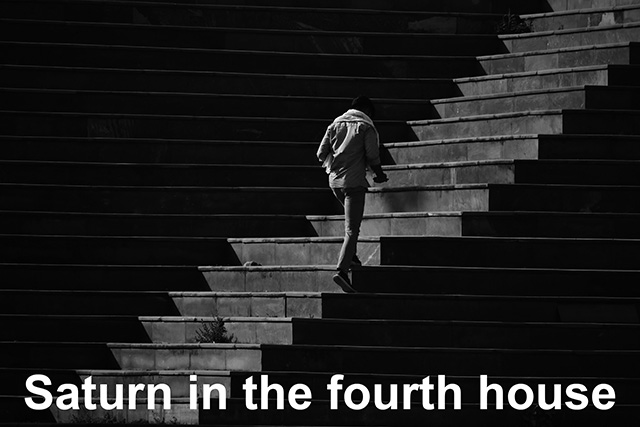
General traits of Saturn in the fourth house
-
A deep sense of responsibility around family or home
Individuals with Saturn in the fourth house often carry a private, internal pressure to hold things together—emotionally or practically—within the family system.
-
Emotionally reserved or guarded at home
They may have learned to contain their feelings early in life, especially if expressions of vulnerability felt unsafe or discouraged.
-
A cautious relationship to emotional security
These individuals often take time to feel safe, even in environments meant to offer comfort. Stability is valued but rarely taken for granted.
-
Mature or serious early home life
Many grew up quickly, often taking on adult roles in childhood or experiencing the home as a place of duty more than ease.
-
Strong identification with privacy and emotional control
Their inner world is protected, sometimes fiercely. They may reveal little and prefer to manage emotions quietly, behind closed doors.
Positive traits of Saturn in the fourth house
-
Emotional resilience built through experience
While not emotionally expressive by nature, they tend to be deeply grounded and composed in moments of emotional crisis.
-
Long-term commitment to personal and family stability
These individuals often build stable homes or inner lives that are secure, self-sufficient, and shaped by clear values.
-
Quiet leadership within the family
They may take on the role of the emotional or practical anchor, becoming someone others trust during difficult times.
-
Inner strength and integrity
The emotional self is not showy but is solid. Over time, this leads to a sense of inner authority and self-respect.
-
Deep loyalty and reliability
They often form enduring attachments, especially with those they consider “home,” and may be protective, loyal, and unwavering in their care.
Negative traits of Saturn in the fourth house
-
Emotional repression or detachment
Feelings may be buried or intellectualized, especially if they were discouraged in early life. This can lead to emotional distance or numbness.
-
Over-identification with the caretaker role
They may struggle to receive care themselves, feeling safer in the role of provider or protector—even at personal cost.
-
Difficulty relaxing into safety
Even when life is stable, there may be a lingering anxiety or sense that the foundation could crumble at any moment.
-
Loneliness within family roles
A sense of emotional isolation is common, particularly if they felt unseen or overburdened as children.
-
Rigid control over emotional boundaries
They may wall off their inner world, making closeness difficult and viewing vulnerability as a threat to their self-containment.
General, positive and negative traits
Saturn expresses a set of general traits when placed in a particular house - these qualities are typically visible in a person’s character and circumstances, regardless of other factors. But how easily these traits function, and whether they tend to help or complicate things, depends on the its relationships with other planets. Harmonious aspects—like sextiles, trines, or quintiles—generally support the more constructive or “positive” expressions of Saturn. Challenging aspects—such as squares and oppositions—can create inner or outer conflict, making the more difficult traits more noticeable. A conjunction is a powerful blending of two planetary energies, but its overall effect depends on whether it receives supportive, conflicting, or mixed influences from the rest of the chart.
Summary
-
Saturn in the fourth house focuses on emotional foundations, early family roles, and long-term inner stability.
-
Core fear: emotional vulnerability, dependence, or instability in the home.
-
Responsibility is expressed through caretaking, emotional restraint, and the desire for a secure foundation.
-
Strengths: resilience, loyalty, inner strength, and protective instincts.
-
Challenges: emotional inhibition, isolation, and over-identification with duty.
Saturn as external challenge
This placement is closely associated with early family hardship. One or both parents may have been strict, emotionally distant, overburdened, or absent due to work, illness, or emotional incapacity. Home life may have lacked warmth, security, or a sense of being emotionally held.
There may have been a premature need to take on adult responsibilities in the household, such as caring for siblings or managing domestic tasks. Saturn in the 4th house often points to a family system where emotional needs were subordinated to duty, tradition, or survival.
Where strength and perseverance are needed
When Saturn is placed in a particular house of the birth chart, it emphasizes that area of life as a site of significant challenge and potential growth. Often this part of life feels weighty, delayed, or burdened with expectation—where we may feel inadequate, ashamed, or simply unsure of ourselves. Yet the very same area can also become a foundation for strength and maturity.
Saturn's influence invites us to engage with these themes not by escaping them, but by showing up with perseverance and intention. Over time, what begins as fear can transform into confidence, and what feels like limitation can become a source of self-respect.
The 4th house relates to home, family, emotional foundations, and the past. Saturn here often signals early emotional restriction, family responsibility, or a feeling of being emotionally on one’s own. This can lead to a strong need for emotional control or difficulty trusting intimacy.
The task is to build an inner sense of safety and belonging that is not dependent on others' approval or past dynamics. Over time, this placement supports emotional resilience and the ability to create a steady, nurturing home base.
Habits that help
- Create weekly rituals for grounding—cooking, cleaning, or tending to your space.
- Start a memory or family journal to explore and reframe personal history.
- Establish boundaries at home that protect your need for rest and emotional safety.
- Cultivate solitude intentionally—practice being at home with yourself.
- Reflect regularly on what "home" and "belonging" mean to you now.
What Saturn in the fourth house really feels like
For those with Saturn in the fourth house, the experience of “home” can be complicated. It may not have been warm or safe in the traditional sense, but rather a place of rules, silence, or unspoken obligations. These individuals often come into adulthood with a heightened sensitivity to instability—emotional, financial, or familial—and a private determination to create something more solid for themselves.
The fourth house governs one’s roots: not just the physical home, but the inner sense of belonging, safety, and emotional ground. When Saturn occupies this space, it can create an early experience of being emotionally alone, even within a full household. Many take on caretaking roles before they’re ready, learning to be composed, responsible, or helpful instead of vulnerable.
As a result, emotional life often goes underground. Feelings may be managed privately, or filtered through logic, productivity, or caretaking. Even when deeply feeling, they may struggle to show it—protecting themselves from emotional exposure or the risk of dependence.
Yet Saturn here also produces remarkable strength. Many with this placement develop a quiet, enduring resilience. They don’t fall apart easily. They know what matters. And while they may take time to trust, their emotional commitments are serious, stable, and deeply protective.
In those with a well-placed or well-supported Saturn, this placement may even show up early as emotional authority: a child who seems unusually self-possessed, or an adult who creates a home defined by integrity, not performance.
The long path to self-respect
The psychological work of Saturn in the fourth house is often internal and invisible to others. It involves slowly dismantling the belief that emotional expression is weak, and learning that care can flow in both directions—not just out, but in.
Early life may have rewarded composure over connection. The individual becomes the helper, the anchor, the one who holds the structure when others fall apart. But this structure can become a prison if it’s never questioned. Over time, the task is to stop equating strength with silence, and to make room for emotional honesty without fearing collapse.
For many, this means redefining what “home” really is. It may no longer be the place they came from, but the one they build—one shaped not just by duty, but by mutual care and emotional truth.
Therapeutic work here often involves recognizing the inner child that had to grow up too fast, and allowing that younger self space to be cared for. It means releasing guilt about rest, or softness, and learning to trust others not only with tasks, but with feelings.
At its most mature, Saturn in the fourth house gives rise to deep emotional authority. Not the kind that demands or controls—but the kind that anchors others simply by being real, grounded, and quietly whole.
Practical reflections and inner questions
- What did I learn early in life about emotions—especially mine?
- Where do I feel most at home—and what defines that feeling?
- How do I handle emotional needs: mine, and others’?
- What kind of foundation am I building for myself—and is it truly nourishing?
- Where do I over-function to maintain control or avoid vulnerability?
- What does emotional strength mean to me now?
About sign placement and aspects
The sign Saturn is in modifies how it functions in the fourth house. For example, Saturn in Cancer may heighten emotional sensitivity while reinforcing the need for control; Saturn in Libra may seek harmony and structure in family dynamics. Supportive aspects from the Moon, Venus, or Neptune may soften emotional defenses, while hard aspects from Mars or Pluto can intensify rigidity, power struggles, or suppression.
Other articles in this series:
Saturn in the first house, Saturn in the second house, Saturn in the third house, Saturn in the fourth house, Saturn in the fifth house, Saturn in the sixth house, Saturn in the seventh house, Saturn in the eighth house, Saturn in the ninth house, Saturn in the tenth house, Saturn in the eleventh house, Saturn in the twelfth house
You might also be interested in:
Saturn in Aries, Saturn in Taurus, Saturn in Gemini, Saturn in Cancer, Saturn in Leo, Saturn in Virgo, Saturn in Libra, Saturn in Scorpio, Saturn in Sagittarius, Saturn in Capricorn, Saturn in Aquarius, Saturn in Pisces
You might also be interested in:
Core principles of Saturn, The Saturn return, Interpretation of Saturn in the birth chart, Saturn in the houses: where life asks us to grow up, Introduction to Saturn in the signs
You might also be interested in: The meaning of the fourth house
You might also be interested in: The complete overview of all the characteristics of Saturn
To read more about the planets in all the signs and in all the houses - click here