The Sun in Cancer – General, positive and negative traits

General traits of the Sun in Cancer
-
Cancer is oriented toward emotional depth and inner continuity.
The Sun in Cancer tends to develop a strong internal life, with identity closely tied to memory, feeling, and emotional resonance. -
There is an instinctive need to nurture and protect.
This may manifest through caregiving roles, emotional attunement, or creating safe environments—for oneself and for others. -
The sense of self is often shaped through emotional bonds.
Relationships—especially familial or chosen kinships—play a central role in how identity is constructed, sustained, and reflected upon. -
Emotional memory plays a key role in self-understanding.
Cancer tends to process experience through the lens of past feelings, carrying emotional narratives that influence present reactions. -
Self-expression is often indirect or symbolic.
Rather than assertive declaration, Cancer may reveal its identity through mood, gesture, atmosphere, or creative containment.
Positive traits of the Sun in Cancer
-
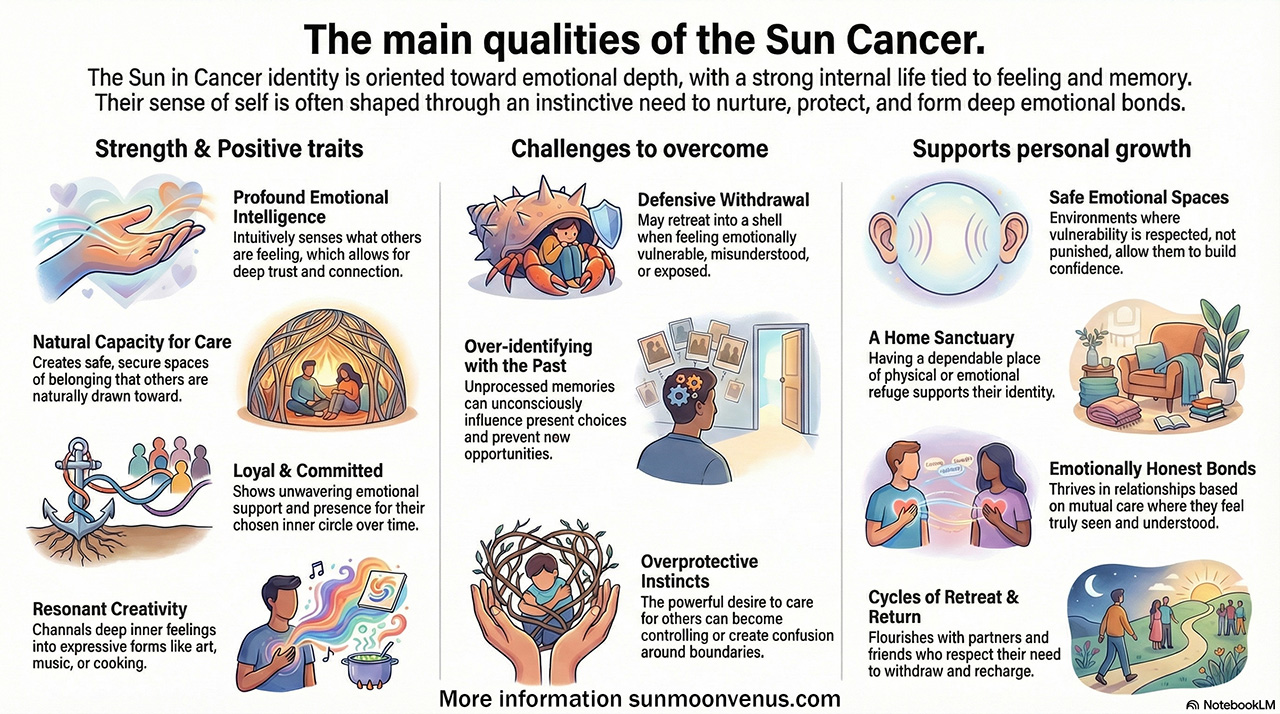
There is a profound emotional intelligence and empathy.
Cancer often senses what others are feeling without words, allowing for intuitive responsiveness and deep relational trust. -
A natural capacity for care fosters strong emotional bonds.
Whether as a friend, partner, or leader, Cancer often creates spaces of belonging and security that others gravitate toward. -
Emotional resilience emerges through inner depth.
By moving through emotional experience rather than bypassing it, Cancer often cultivates a quiet strength rooted in authenticity. -
Loyalty and commitment are expressed through consistent presence.
Cancer tends to show up emotionally over time, particularly for those it considers part of its inner circle. -
Creativity is often expressed through emotionally resonant forms.
Cancer may channel its inner life into music, art, cooking, design, or other symbolic languages that evoke feeling and memory.
Negative traits of the Sun in Cancer
-
Emotional sensitivity can lead to withdrawal or defensiveness.
When feeling misunderstood or exposed, Cancer may retreat rather than risk further vulnerability, limiting open dialogue. -
There may be a tendency to over-identify with the past.
Unprocessed emotional memories can shape present choices in unconscious ways, sometimes preventing new possibilities from emerging. -
Mood fluctuations may obscure clear self-expression.
When overwhelmed by inner states, Cancer may find it difficult to articulate needs directly, leading to misunderstanding or emotional distance. -
A protective instinct can become controlling or overbearing.
The desire to care for others may cross into emotional enmeshment or boundary confusion, especially in close relationships. -
Fear of rejection may inhibit authentic risk-taking.
To avoid emotional exposure, Cancer may hesitate to assert itself fully, particularly in unfamiliar or competitive environments.
General, positive and negative traits
Each planet expresses a set of general traits when placed in a particular sign—these qualities are typically visible in a person’s character, regardless of other factors. But how easily these traits function, and whether they tend to help or complicate things, depends on the planet’s relationships with other planets. Harmonious aspects—like sextiles, trines, or quintiles—generally support the more constructive or “positive” expressions of the planet. Challenging aspects—such as squares and oppositions—can create inner or outer conflict, making the more difficult traits more noticeable. A conjunction is a powerful blending of two planetary energies, but its overall effect depends on whether it receives supportive, conflicting, or mixed influences from the rest of the chart.
The Sun in Cancer – A path of emotional depth, security, and caring for others
The Sun in astrology represents the process of becoming oneself, of discovering a conscious and integrated identity. In Cancer, this journey is rooted not in outward assertion but in emotional attunement, inner safety, and the slow cultivation of trust. Cancer is a water sign, cardinal in nature, and ruled by the Moon—symbol of memory, feeling, and instinct.
The Cancer Sun individual often experiences identity as something fluid and cyclical, shaped by emotional tides and the early imprint of familial relationships. Over time, their task is to distinguish personal feeling from emotional enmeshment, and to transform vulnerability from something they must protect into a strength they can embody.
Identity formation and personal growth
People with the Sun in Cancer often begin life highly responsive to the emotional environments around them. Their early sense of self is closely tied to how safe they feel, how much emotional consistency they experience, and what roles they are expected to play within their families. As they mature, they may discover how much of their identity has been built around the emotional needs of others.
The work of growth involves turning inward with honesty, understanding where sensitivity becomes self-erasure, and allowing the self to emerge as distinct from what others feel. Over time, the Cancer Sun individual can become not only a caregiver but also someone who offers presence and emotional maturity—without sacrificing their own truth.
Developmental challenges
-
Over-identification with family roles
Cancer Suns often define themselves through family expectations or early emotional bonds, and struggle to claim a separate identity in adulthood. -
Difficulty setting emotional boundaries
Their deep empathy can blur the lines between their own feelings and those of others, leading to emotional burnout or co-dependency. -
Fear of exposure or rejection
The need to feel safe may lead to self-protection through withdrawal, passivity, or avoidance of emotional confrontation. -
Clinging to the past or unresolved memories
Cancer’s memory is vivid and long, but without integration, it can lead to stagnation, guilt, or idealization of what was. -
Tendency to nurture at their own expense
Caring for others can become a way to earn love or feel useful, but it risks eroding self-worth if not balanced with self-care.
Supportive environments: Relationships, work & emotional conditions
-
Relationships based on emotional honesty and mutual care
Cancer Suns thrive when they feel seen, not just for what they provide, but for who they are emotionally and internally. -
Work environments that value empathy, creativity, and emotional insight
Healing professions, education, hospitality, or creative roles where emotional nuance is an asset tend to align well with their nature. -
Emotional spaces that offer safety and slow unfolding
Environments where vulnerability is not punished but respected allow Cancer Suns to grow in confidence and trust. -
Connection to home and sanctuary
Whether through physical space or chosen family, having a dependable place of emotional refuge supports identity formation. -
Work or relationships that allow for cycles of retreat and return
Cancer Suns benefit from rhythms that honor their need to withdraw and recharge before reengaging with the outer world.
When the Sun is strong in Cancer
The Sun in astrology represents the core of our identity: our sense of self, our creative vitality, and our capacity to make choices that feel authentic. When the Sun is strong in a birth chart—regardless of sign—it often describes someone who is self-assured, expressive, and able to face life’s challenges with purpose.
What tends to be absent in these cases is a persistent sense of regret over past decisions, a harsh or crippling self-criticism, or a debilitating shame about one’s imperfect or unfinished qualities. Instead, there is often an ongoing commitment to growth—not driven by insecurity, but by a desire to refine one’s skills, contribute meaningfully, and express oneself through work, creativity, or service to others.
A strong Sun doesn’t mean a perfect life, but it can reflect a deep and evolving sense of inner direction—one that supports choices aligned with personal values and long-term goals, while also making space for the needs, perspectives, and growth of others.
When the Sun is in Cancer, the self is shaped through emotional connection, memory, and a sense of belonging. A strong Cancer Sun often shines in people who are quietly protective, deeply intuitive, and sensitive to the needs of others. Their identity may be closely tied to home, family, or inner emotional landscapes. With growth, the instinct to nurture can deepen into a more conscious capacity to care—for themselves as much as for others—creating a secure foundation from which they can lead with emotional authenticity.
Want to learn more about the difference between a strong, big, or weak ego, and the Sun in the birth chart? Click here
The symbols of Sun and Moon and the parents
While the Sun in a natal chart primarily symbolizes identity, vitality, and the developing sense of self, it also reflects—often subtly—some of the defining qualities of the father or dominant male figures in a person's life. These may include not only external characteristics, such as ambition or charisma, but also internalized models of authority, willpower, and creative self-expression.
Similarly, the Moon, commonly associated with emotional life, instinctive needs, and psychological safety, often carries the imprint of the mother or influential female caregivers. It reveals not only how we feel and seek comfort, but also how early nurturing experiences have shaped our capacity to respond emotionally and care for ourselves and others.
Signs, houses, aspects and personal growth
To fully understand the meaning of the Sun in a birth chart, one must look beyond its sign and consider its house position, which reveals the life areas where identity seeks expression. Equally important are the aspects it makes to other planets, shaping how the core self integrates—or struggles to integrate—with other dimensions of the psyche.
Transits and secondary progressions show how the Sun’s energy evolves over time, reflecting key phases in psychological development and shifts in self-awareness. An experienced astrologer weaves together this multi-layered complexity and translates it into clear, meaningful language that supports deeper insight and growth.
Other articles in this series:
Sun in Aries, Sun in Taurus, Sun in Gemini, Sun in Cancer, Sun in Leo, Sun in Virgo, Sun in Libra, Sun in Scorpio, Sun in Sagittarius, Sun in Capricorn, Sun in Aquarius, Sun in Pisces
You might also be interested in:
Sun in the first house, Sun in the second house, Sun in the third house, Sun in the fourth house, Sun in the fifth house, Sun in the sixth house, Sun in the seventh house, Sun in the eighth house, Sun in the ninth house, Sun in the tenth house, Sun in the eleventh house, Sun in the twelfth house
You might also be interested in: The meaning of the Sun in the birth chart
You might also be interested in: A strong, big, or weak ego and the Sun in the birth chart
You might also be interested in: The complete overview of all the characteristics of the Sun
To read more about the planets in all the signs and in all the houses, click here.